
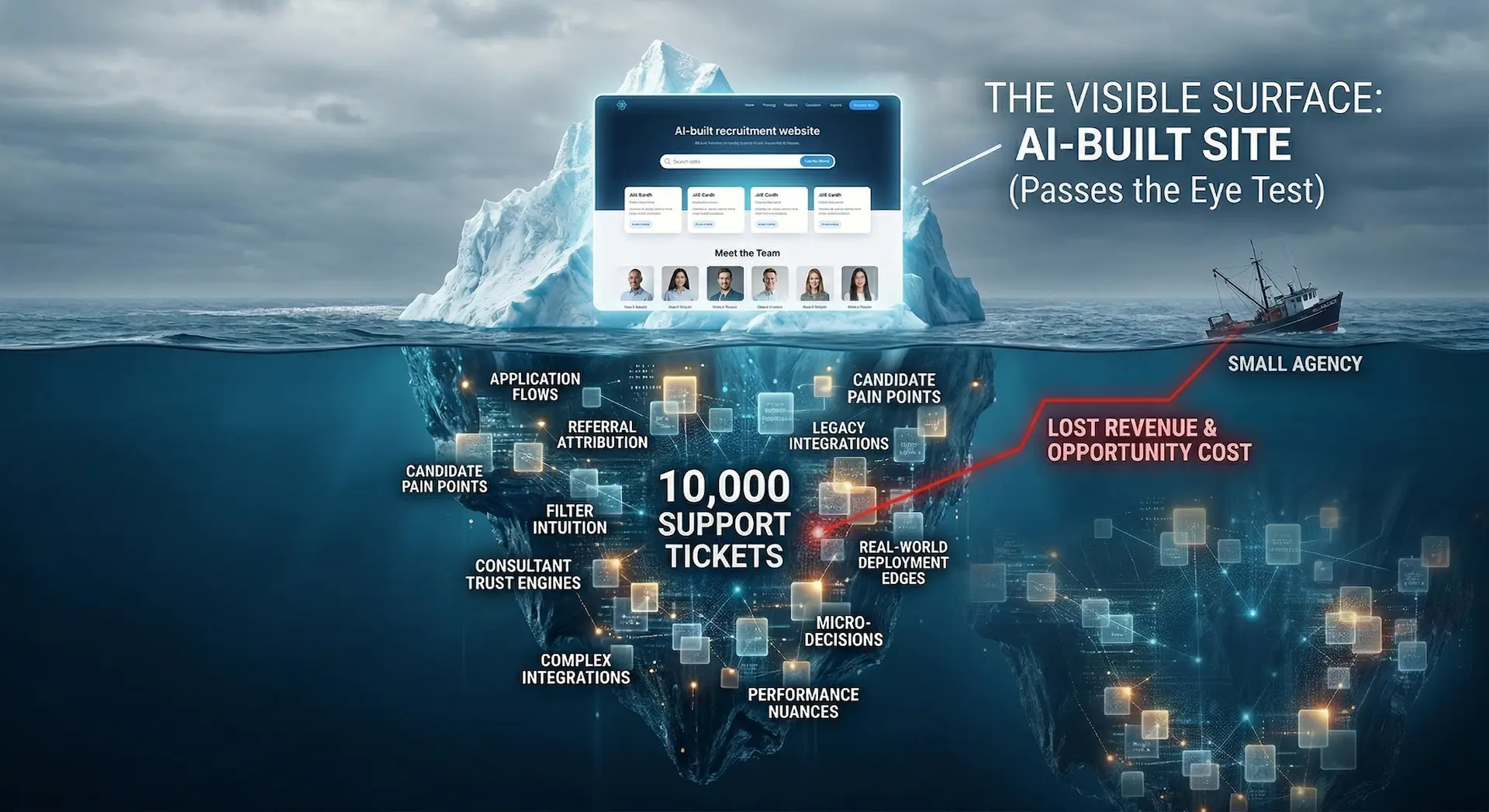
One of our clients recently moved to an AI-built recruitment website.
They are a small agency. Last year, through their Refari-powered site, they made four placements directly attributed to their web presence. For a large agency, four placements is a rounding error. For a small agency, four placements can be the difference between hiring next year and downsizing. It is the difference between investing in growth and just keeping the lights on.
Based on what we have seen of their new implementation, our honest estimate is they will make one placement through it this year. Maybe none.
What happens to the other three? There are a few scenarios, and none of them are good.
Maybe those roles simply do not get filled through the website. The candidates who would have found the listing, made it through the application flow, and ended up placed never apply. They bounce instead. The revenue disappears. For a small agency, that could be $45,000 to $80,000 in lost fees. That is not a bad quarter. That is a threat to the business.
Or maybe the agency compensates. They spend more on third-party job board advertising to replace the organic traffic their own website used to generate. They spend more hours actively sourcing candidates they used to attract passively. The placements still happen, but now they cost more money and more time. And that time has to come from somewhere. It comes from the hours that would have gone into winning new clients, servicing existing ones, or working other roles. The financial cost of replacing what the website used to do for free is only the beginning. The opportunity cost, the roles that do not get worked, the client relationships that thin out, the growth that stalls, is where the real damage accumulates.
Or, worst case, both things happen at once. Some placements are lost entirely. The rest cost more to make. The team is stretched thinner. Service quality drops. And a small agency that was building momentum finds itself going backwards. Not because the market got harder, but because their website stopped doing its job.
The new site still looks fine. It still displays jobs. But it has stopped doing the invisible work that was quietly driving revenue and saving the team time on every placement it touched.
We have processed over 10,000 support tickets. We have sent millions of job alerts. We have handled millions of applications through our platform. Every one of those interactions taught us something about how recruitment technology actually works in the real world. Not in a demo. Not in a clean environment. On real agency websites, with real candidates, making real decisions about their careers. Here is what we know about the 90% that sits below the surface.
It looks exactly the same. That is the problem.
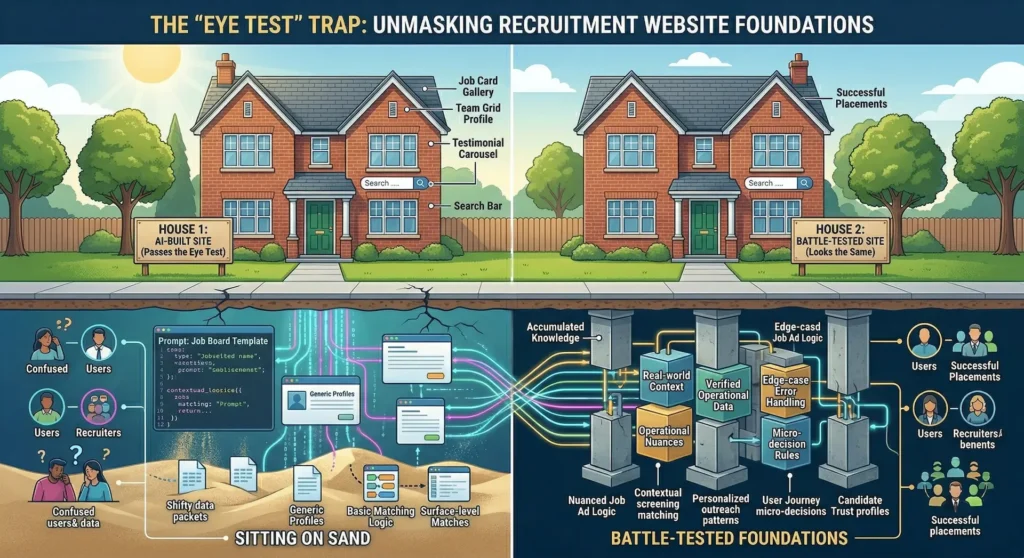
Here is what makes AI-built recruitment websites so dangerous. They pass the eye test.
Side by side, an AI-generated recruitment site and a battle-tested one look almost identical. Same job cards. Same team grid. Same testimonial carousel. Same search bar. If you are an agency owner reviewing a demo, or a marketing manager comparing screenshots, you genuinely cannot tell the difference. It is like comparing two houses from the street. Same brick, same roof, same front door. You cannot see which one has foundations and which one is sitting on sand.
And this is a trap that the recruitment industry should recognise, because you are already living through the same problem on the other side of your business.
AI can write a job ad that looks like a job ad. It will have the right sections, the right tone, the right keywords. But anyone who has placed candidates knows that the difference between a job ad that fills a role and one that does not often comes down to nuances that are not visible in the text. Understanding which requirements are actually flexible. Knowing that “collaborative culture” means something different at a 10-person startup than at a bank. Recognising that the salary band needs to be adjusted for the market because the last three candidates rejected offers below the midpoint.
AI can screen a CV that looks like a good match. Right keywords, right years of experience, right job titles. But a recruiter who has worked the desk knows that the candidate who spent two years at that particular company probably left because of the restructure. That the gap in their CV aligns with the industry downturn that hit that sector. And that their “project management” experience was actually hands-on delivery, not coordination, which is exactly what this client needs but did not know how to articulate.
AI can send an outreach message that looks professional. But it does not know that this candidate rejected a similar role six months ago because of the commute. That they just posted about finishing a certification that changes their market value. Or that they respond to direct questions about the role and ignore anything that opens with flattery.
The pattern is always the same. AI produces output that passes the eye test but fails the outcome test. It looks like the real thing. It reads like the real thing. It just does not perform like the real thing, because performance comes from the accumulated knowledge of what works and what does not in specific, real-world contexts.
A recruitment website is no different. The AI-built version has job cards and team photos and testimonials and an apply button, just like the real thing. But it is missing the thousands of micro-decisions that determine whether a candidate actually completes an application, whether a referral actually gets tracked, whether a consultant’s profile actually builds trust, whether a testimonial actually converts a visitor into an applicant. Those decisions do not show up in a screenshot. They show up in your placement numbers twelve months later.
Your job board is a placement engine (or it is not)
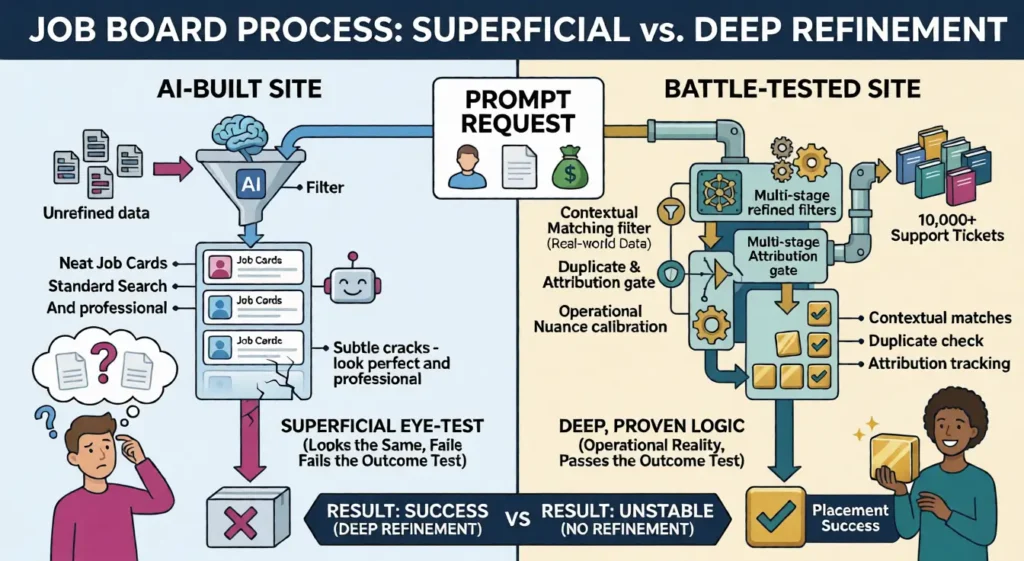
The job board is the highest-stakes component on any recruitment website. It is where candidates decide in seconds whether to engage or bounce. An AI gives you job cards with a search bar. Reality demands something else entirely.
Real recruitment agencies operate with hundreds of jobs across dozens of categories, locations, and work types. Their candidates need to combine filters intuitively, see how many jobs match each option, share a filtered view with a colleague, and come back to it a week later from a bookmark. Their recruiters need filters and tools that candidates do not even see. And there are interaction patterns between filter types that only become obvious when you watch real candidates use them. Behaviours we discovered and refined over years of deployment that fundamentally changed how our filter system works.
Then there is the application flow. Building a form with name, email, and a file upload takes minutes. Building an application flow that works for recruitment takes years. What happens when the role requires screening questions after submission? When the agency has legal terms the candidate must acknowledge first? When the candidate applied last week and comes back? When a recruiter accidentally tries to apply to their own agency’s listing? When the application originates from a referral link and the attribution needs to survive the entire journey?
Each of these scenarios was a real support ticket. One of ten thousand. Each one required understanding the recruitment workflow deeply enough to know what the right behaviour should be. Not just technically, but operationally. An AI will build you the form. It has no concept of the workflow the form lives inside.
Your "Meet the Team" page is doing more than you think
Most agency websites have a team page. Grid of headshots, names, job titles. An AI can build that in minutes.
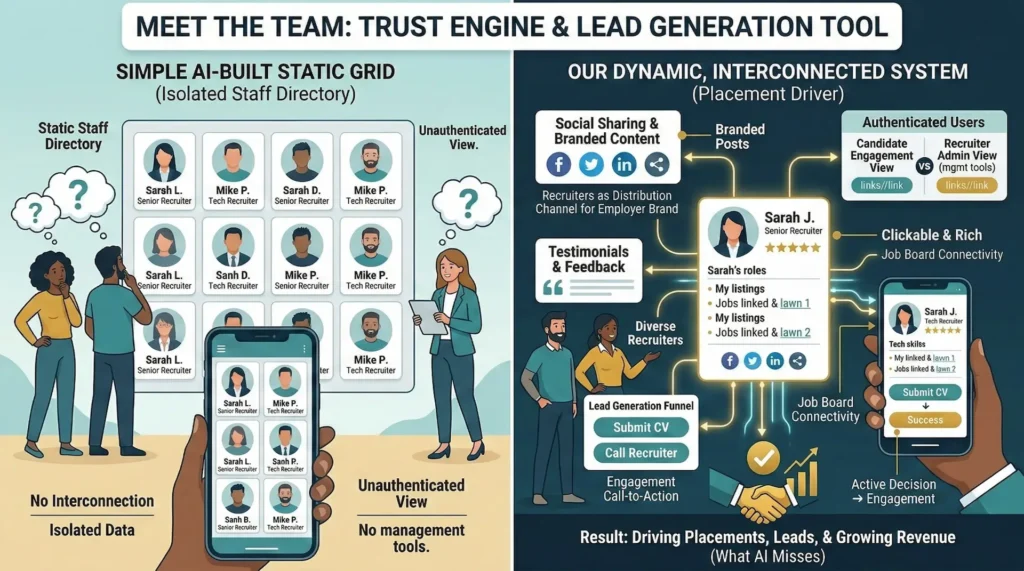
But a team page on a recruitment website is not a staff directory. It is a trust engine and a lead generation tool.
When a candidate lands on your team page, they are making a decision about whether to engage with your agency. The consultants they see, the way those consultants are presented, the ability to click through to a profile and see that person’s specialisations, their ratings, their current listings. That is what converts a passive visitor into someone who submits their CV or picks up the phone.
Our consultant profiles connect directly to the job board. Click a recruiter, see their roles. Click a role, see who is recruiting it. The consultant’s rating, built from real candidate and client feedback, displays alongside their profile, building credibility that a static headshot never could. Recruiters can share their own profiles to social media with branded content, turning every consultant into a distribution channel for the agency’s employer brand.
None of this works if the team page is a static grid. It works because it is a connected component in a larger system. Linked to jobs, linked to testimonials, linked to the referral engine, linked to authentication so recruiters see management tools while candidates see engagement tools.
An AI builds you a team grid. It does not build you a team grid that drives placements.
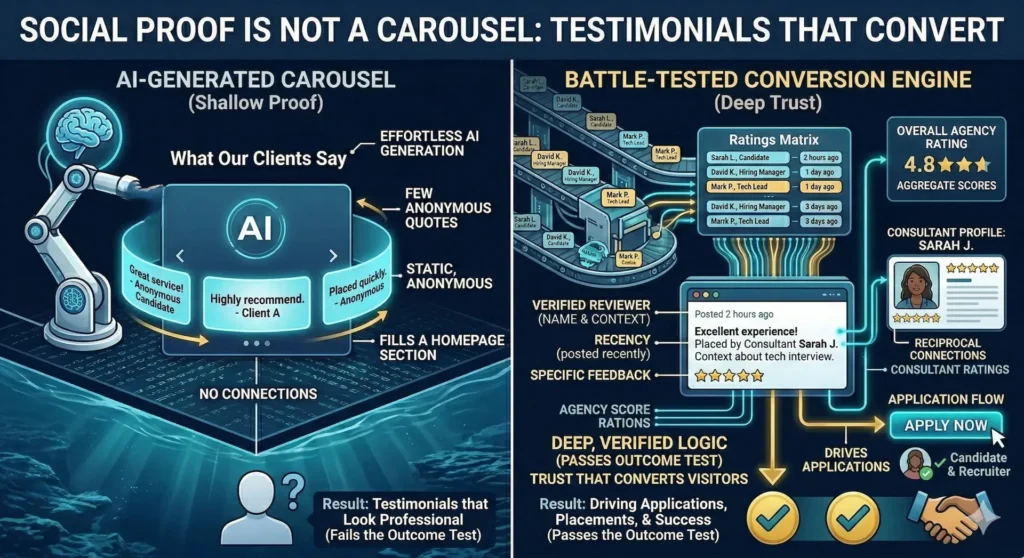
Social proof is not a testimonial carousel
Every agency website has testimonials. A few quotes in a slider. An AI generates this effortlessly.
But testimonials on a recruitment website serve a specific conversion purpose. They answer the question “should I trust this agency with my career?” or “should I trust this agency with my hiring?” That question is not answered by three anonymous quotes rotating in a carousel.
It is answered by volume, recency, and specificity. How many reviews? How recent? Can I see the reviewer’s name and context? Can I see the agency’s overall rating? Can I see ratings for the specific consultant I am about to work with?
Our testimonials and ratings systems are interconnected. They pull from verified interactions. They display aggregate scores alongside individual reviews. They connect to consultant profiles so a candidate reading a testimonial can click through to the recruiter it mentions. They are designed to build the kind of trust that actually influences a candidate’s decision to apply, not just fill a section of the homepage.
The difference between “testimonials that look professional” and “testimonials that convert visitors” is entirely invisible in a screenshot.
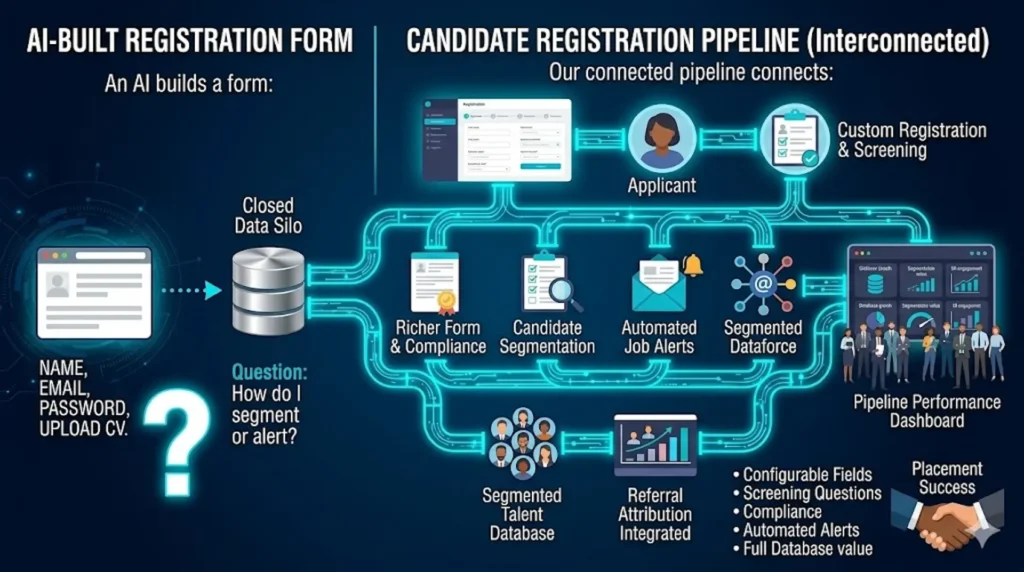
Candidate registration is a pipeline, not a form
An AI builds you a registration form. Name, email, password, upload CV. Done.
In recruitment, candidate registration is the front door to your talent pipeline. It is how you build a database of candidates who are interested in your agency but may not be ready to apply for a specific role today. It is one of the most valuable long-term assets a recruitment agency has.
Which means registration needs to handle configurable fields that vary by agency (some want LinkedIn URLs, some want phone numbers, some want both, some want neither required), screening questions that help recruiters segment the pipeline, policy acknowledgements for compliance, post-registration redirects to custom landing pages, and integration with the job alert system so registered candidates automatically start receiving relevant listings.
It also needs to connect to everything else. A registered candidate who later applies for a job should not have to re-enter their details. A candidate who registered via a referral link needs that attribution preserved. A recruiter viewing their pipeline needs to see which candidates came through the website versus other channels.
An AI builds you a registration form. It does not build you a registration form that feeds a pipeline that connects to a job board that connects to a referral engine that connects to an alert system.
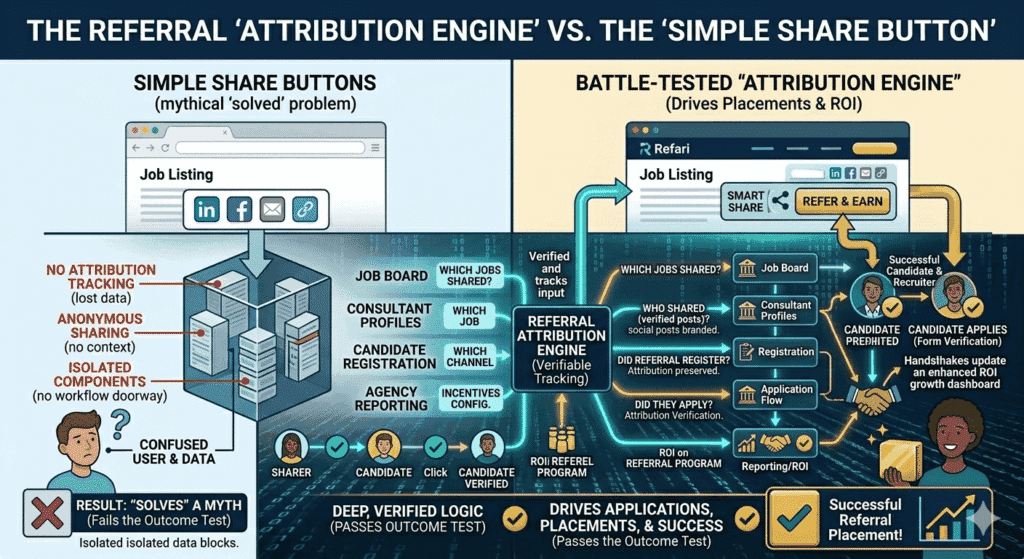
Your referral programme lives (or dies) on your website
Social sharing sounds like a solved problem. Link to LinkedIn, link to Facebook, done.
What recruitment agencies actually need is a referral attribution engine. They need to know which person shared which job through which channel, whether that share led to an application, and whether that application led to a placement. They need configurable referral incentives. They need to track engagement across email, social, and direct link shares. They need this data to flow back into their recruitment pipeline so they can measure ROI on their referral programme.
We did not set out to build this. We set out to add share buttons. Then an agency asked how they would know if a share actually worked. Then another asked if they could reward referrals. Then another asked if recruiters could share branded content to their company LinkedIn page. Thousands of support tickets and feature requests later, what started as share buttons became one of the most complex subsystems in our product.
And it touches everything. The job board (which jobs were shared), consultant profiles (who shared them), candidate registration (did the referred candidate sign up), the application flow (did they apply, and does the attribution survive the journey), and the agency’s reporting (what is the ROI on the referral programme).
That is the pattern with recruitment technology. Every “simple” feature is a doorway to a workflow you did not know existed.
It works in the demo. Your website is not the demo.
Here is something that catches every agency off guard. The recruitment website you were shown, the one that looked perfect in the demo, was built and tested in a clean environment. Your actual website is not a clean environment.
Your website has a theme. It has plugins. It has fonts, analytics scripts, cookie banners, chat widgets, and whatever else your web designer or marketing team has added over the years. Every one of these things can interfere with an embedded job board or registration form in ways that nobody predicted. A button that is the wrong colour. A form where the spacing has collapsed. A filter sidebar that overlaps with your navigation. A mobile layout that does not quite work because your theme handles screen sizes differently than the demo environment did.
And here is the worst part. You will probably never find out.
When a candidate lands on your job board and something looks off, a form that seems broken, a layout that feels wrong, an apply button that does not respond the way they expect, they do not file a support ticket. They do not send you an email. They do not call your office. They leave. They go to the next agency. They find the same role on a job board that works. You never hear from them. You never know they were there.
You check the website from your laptop and it looks fine. It looked different on theirs.
We know this because we have deployed across hundreds of real agency websites. WordPress, Squarespace, Wix, custom-built sites, and everything in between. Every edge case we handle exists because a real agency’s website broke something we did not anticipate, and a real candidate had a bad experience that we only caught because we were actively looking for it. That knowledge came from thousands of deployments, not from a prompt.
An AI-built solution is tested in isolation. It is deployed into chaos. And the gap between the two is where candidates disappear.
The compound problem
Here is the part that no amount of AI prompting can replicate. Everything connects to everything.
Any individual component on this list, in isolation, is buildable. An AI can generate a job board. It can generate a team page. It can generate a testimonial widget and a registration form and share buttons.
The danger is the compound effect.
A candidate finds a job through a filtered search, clicks the recruiter’s name, reads their profile, sees their rating, checks a testimonial, goes back to the job, and applies. That is five components maintaining shared context across a single user journey.
A recruiter shares a job to LinkedIn from the job board, a candidate clicks the referral link, registers on the site, receives a job alert a week later, and applies. That is the referral engine, social sharing, registration pipeline, alert system, and application flow all passing attribution data between them.
An agency admin needs to see which website components are driving applications, which consultants’ profiles are generating the most engagement, and which referral channels have the highest conversion rate. That requires every component to be reporting into a unified system.
We have dozens of interconnected systems managing the relationships between these components. The complexity is not in any single component. It is in the matrix of interactions between all of them. This is the kind of complexity that emerges from processing millions of real applications and millions of real job alerts across hundreds of agency websites. It is effectively impossible to spec upfront.
An AI builds components in isolation. Recruitment technology lives in the connections.
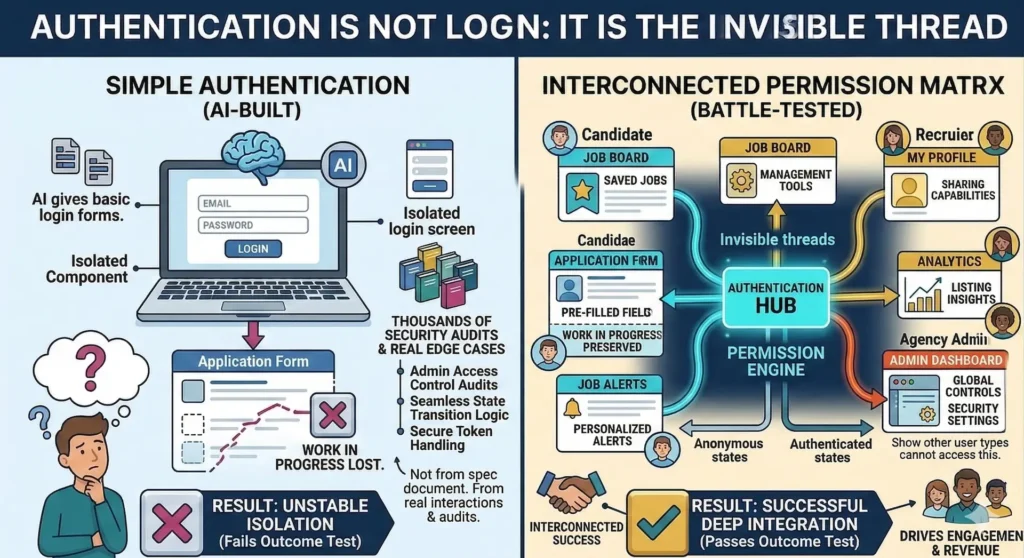
Authentication is not login. It is the thread that ties everything together.
An AI gives you email and password. Maybe OAuth if you ask nicely.
On a recruitment website, authentication is the invisible thread that connects every component into a coherent experience. A logged-in candidate sees saved jobs on the job board, pre-filled fields on application forms, and personalised job alerts. A logged-in recruiter sees management tools on the job board, sharing capabilities on their profile, and analytics across their listings. An agency administrator sees controls that neither candidates nor consultants can access.
Different user types see different features across every single component. Some actions require authentication, some work anonymously but lose tracking, and the transition between anonymous and authenticated states needs to be seamless across every component without losing work in progress.
This permission model gates every feature across every component on the site. It did not come from a spec document. It came from real users encountering real edge cases across thousands of interactions. An admin who could see things they should not. A candidate who lost their half-completed application when prompted to sign in. A security audit that found token handling edge cases nobody had considered.
The real cost of "good enough"
The danger is not that an AI-built recruitment website does not work. It is that it appears to work. In the demo, on the dev machine, with test data, for one user following the happy path.
Then a year passes. And the costs reveal themselves. Not as a single line item, but as a slow bleed across the entire business.
Maybe it is lost revenue. Placements that the website used to generate quietly just stop happening. Candidates bounce. Applications do not convert. Referrals go untracked. For a small agency, three lost placements is not a bad quarter. It is the margin between growth and contraction.
Maybe it is increased spend. The agency compensates with more job board advertising, more sourcing hours, more recruiter time on the phone. The placements still happen, but they cost more to make. And that cost is not captured anywhere as “website failure.” It shows up as higher cost-per-hire, bigger ad invoices, and recruiters wondering why they are working harder for the same results.
Maybe it is opportunity cost. The hours spent compensating for what the website used to do are hours not spent winning new clients, building relationships, or working other roles. The team stretches thinner. Service quality slips. And in recruitment, service quality is reputation. The thing that determines whether clients come back and whether candidates recommend you.
Most likely, it is all three at once. Some revenue lost, some costs increased, some opportunities missed. None of it traced back to the website. None of it flagged by an error log or a bug report. Just a gradual sense that the business is not moving the way it should. That the market has gotten harder. That the team needs to do more. That growth has stalled for reasons nobody can quite pin down.
That is the most dangerous kind of failure. The kind the business absorbs without ever diagnosing.
Every feature across our platform exists because someone needed it and did not have it. That is what 10,000 support tickets, millions of job alerts, and millions of processed applications teach you. Not theory. Not best practice. The specific, hard-won knowledge of what actually works when real candidates interact with real job boards on real websites. It is the reason a candidate completes an application instead of abandoning it. The reason a referral gets tracked from social share to signed contract. The reason a consultant’s profile builds trust instead of just taking up space. The reason all of it works together instead of sitting side by side.
For a large agency, a website that underperforms is an inefficiency. For a small agency, it can be the difference between growing next year and not. That is not a technology decision. That is a business decision.
An AI can build you a recruitment website in an afternoon. It just cannot build you one that makes placements.